
Leaders in precision child health
Leaders in precision child health
The International Precision Child Health Partnership (IPCHiP) brings together some of the world’s top experts in paediatrics and genomics to improve diagnoses, implement personalized treatment decisions, and develop new therapeutic targets and treatments that will benefit children around the world.
About Us
IPCHiP brings together four paediatric hospitals—Boston Children’s Hospital (Boston, United States), University College London Great Ormond Street Institute for Child Health and Great Ormond Street Hospital (London, United Kingdom), the Murdoch Children’s Research Institute with The Royal Children’s Hospital (Melbourne, Australia), and The Hospital for Sick Children (Toronto, Canada) to pool medical and scientific expertise in order to analyze medical and genomic data and accelerate discovery and therapeutic development.


The Hospital for Sick Children (SickKids)
Toronto, Canada
SickKids, affiliated with the University of Toronto, is Canada’s most research-intensive hospital and the largest centre dedicated to improving children’s health in the country.
Boston Children’s Hospital (BCH)
Boston, United States of America
BCH, affiliated with Harvard Medical School, has a long and storied history of research accomplishments, and receives more funding from the United States National Institutes of Health (NIH) than any other paediatric hospital.


Melbourne Children’s Campus
Melbourne, Australia
Melbourne Children’s Campus is a partnership between the Royal Children’s Hospital, the Murdoch Children’s Research Institute (MCRI) and the University of Melbourne Department of Paediatrics and is focused on advancing child and adolescent health through prevention, early intervention and health promotion, together with the highest quality clinical care, outstanding research and comprehensive education and training.
University College London (UCL) Great Ormond Street (GOS) Institute for Child Health (ICH) and Great Ormond Street Hospital (GOSH)
London, England
The UCL GOS ICH which, together with its clinical partner GOSH, forms the largest concentration of children’s health research in Europe.
Objectives
By bringing together leading children’s hospitals across the globe, IPCHiP can provide leadership in implementation change in clinical practice and generate evidence needed to build bridges between clinical and fundamental research. IPCHiP aims to:
- Accelerate discoveries by developing methods for acquiring, sharing and analyzing genomic and phenotypic data across institutions
- Facilitate current and future collaborations among paediatric hospitals
- Establish an international clinical trial network of well-characterised rare disease cohorts to evaluate targeted therapies and disseminate knowledge
- Enable further scientific investigation of rare diseases
- Create innovative diagnostic and therapeutic solutions for rare diseases

Gene-STEPS
IPCHiP’s flagship project, Gene-STEPS (Shortening Time of Evaluation in Paediatric Epilepsy Services), has established the largest prospective cohort to date to study the utility of genome sequencing to diagnose early-onset epilepsy and measure the impact of rapid genetic diagnosis.
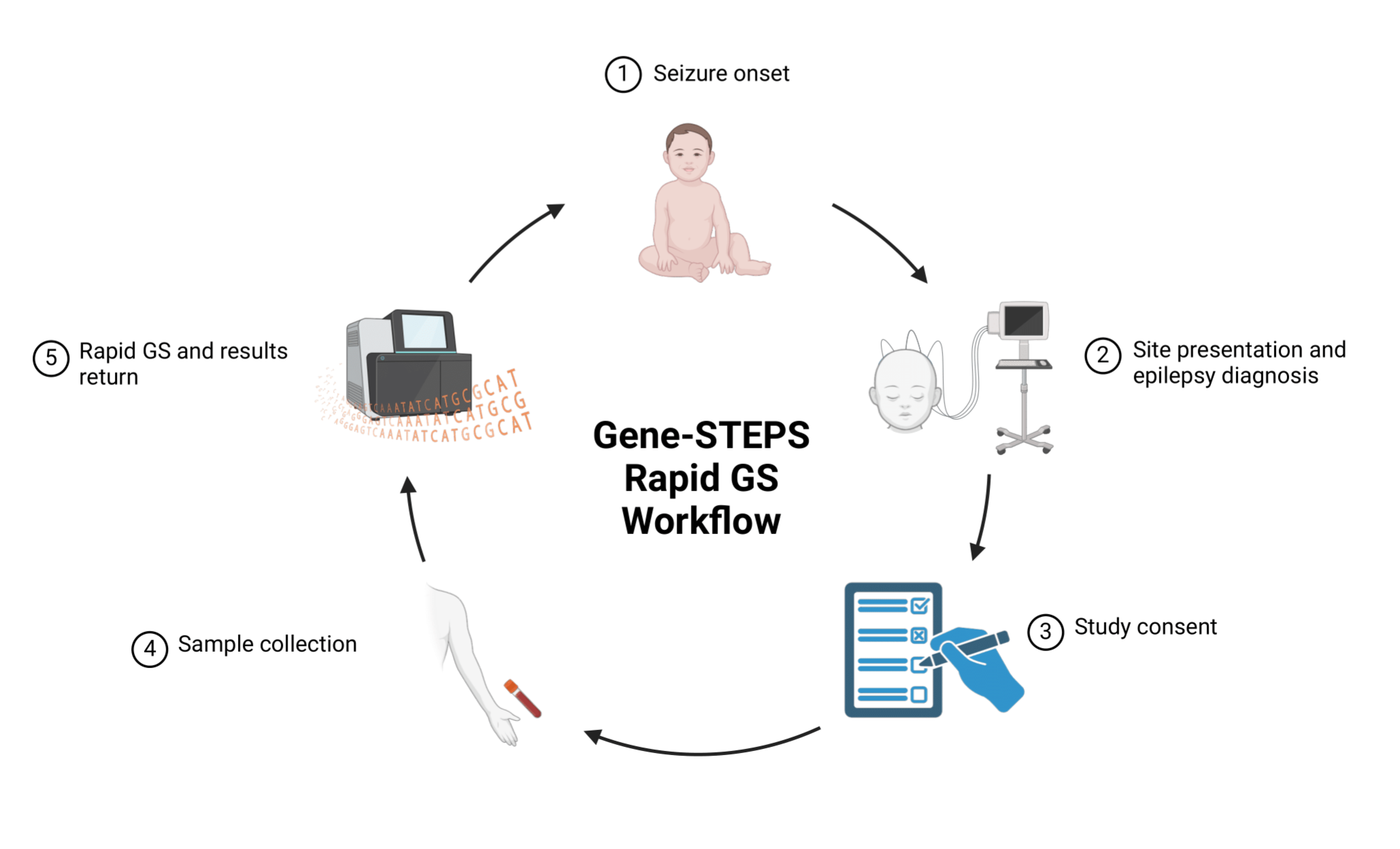
Investigators at each site are prospectively enrolling families with infants under the age of one with epilepsy, conducting rapid whole genome sequencing, prescribing treatment based on the findings as appropriate, and following their development long term.
The study compares infants who receive a genetic diagnosis with those for whom no genetic answer can be found. It also participates in and develops methods for gene discovery and data sharing to improve diagnosis and clinical outcomes. Gene-STEPS is working towards a target recruitment of 600 infants with epilepsy within three years.
GEMSTone
GEMSTone (Genetic Evaluation for Management and Support of low Tone): a multi-centre prospective evaluation of the impact of early genetic diagnosis for hypotonia.
IPCHiP’s second collaborative study, GEMSTone, is an international, multi-site effort evaluating the impact of early genetic diagnosis for infants with unexplained hypotonia—a common and clinically challenging condition that often requires neonatal intensive care. By implementing rapid genome sequencing (rGS) and research-based long-read genome sequencing (LRGS) for children under 12 months old, GEMSTone aims to identify genetic causes, delineate clinical trajectories, assess outcomes, and trial LRGS as a diagnostic technology alongside conventional rGS. The study is unique in its prospective collection of phenotypic and developmental data, and it will help develop strategies for cross-institutional data sharing, potentially improving diagnosis and management for this vulnerable population.
Leadership

Stephen Scherer 
SickKids
Toronto, Canada
Chief of Research

Christian Marshall
SickKids
Toronto, Canada
Clinical Lab Director

Nancy Andrews 
Boston Children’s Hospital
Boston, United States
Chief Scientific Officer

Alan Beggs
Boston Children’s Hospital
Boston, United States
Director, Manton Center for Orphan Disease Research

Piotr Sliz
Boston Children’s Hospital
Boston, United States
Chief Research Information Officer

Kathryn North 
Murdoch Children’s Research Institute
Melbourne, Australia
Director

John Christodoulou
Murdoch Children’s Research Institute
Melbourne, Australia
Professor

Helen Cross 
UCL GOS ICH
London, United Kingdom
Director

Neil Sebire
UCL GOS ICH
London, United Kingdom
Chief Research Information Officer
Training, Education & Mentorship
The IPCHiP consortium fosters opportunities for collaboration across its member sites to advance research, disseminate knowledge, and implement solutions to enable precision medicine for children.
To cultivate global expertise and knowledge exchange in the next generation of leaders in healthcare & biomedical sciences, each IPCHiP site has committed funding to support opportunities for staff and trainees from their respective institutions. This includes:
Cross-training and Upskilling
- Hosting or sending individuals for academic exchange between IPCHiP institutions
Driver Projects and Collaborative Endeavors
- Travel funding to facilitate collaboration in shared initiatives between IPCHiP sites
Annual IPCHiP Retreat
- Funding to sponsor nominated trainees from each site to attend the annual retreat
Conferences
- Travel funding can be awarded to fund attendance to conferences relevant to IPCHiP initiatives and/or where IPCHiP work is presented
Other opportunities:


Publications
Browse academic papers authored by the IPCHiP Consortium
- Nguyen JNH, Lachgar-Ruiz M, Higginbotham EJ, et al. Diagnostic Yield of Comprehensive Reanalysis After Nondiagnostic Short-Read Genome Sequencing in Infants With Unexplained Epilepsy. Neurology. 2026;106(6):e214645. doi:10.1212/WNL.0000000000214645🔗
- Howell KB, White SM, McTague A, et al. International Precision Child Health Partnership (IPCHiP): an initiative to accelerate discovery and improve outcomes in rare pediatric disease. NPJ Genom Med. 2025;10(1):13. Published 2025 Feb 27. doi:10.1038/s41525-025-00474-8🔗
- Morton SU, Costain G, French CE, et al. Exome and Genome Sequencing to Diagnose the Genetic Basis of Neonatal Hypotonia: An International Consortium Study. Neurology. 2025;104(1):e210106. doi:10.1212/WNL.0000000000210106🔗
- AlMail, A., Jamjoom, A., Pan, A. et al. Consensus reporting guidelines to address gaps in descriptions of ultra-rare genetic conditions. npj Genom. Med. 2024;9(27). doi:10.1038/s41525-024-00408-w🔗
- D’Gama AM, Mulhern S, Sheidley BR, et al. Evaluation of the feasibility, diagnostic yield, and clinical utility of rapid genome sequencing in infantile epilepsy (Gene-STEPS): an international, multicentre, pilot cohort study. Lancet Neurol. 2023;22(9):812-825. doi:10.1016/S1474-4422(23)00246-6🔗
- Morton SU, Christodoulou J, Costain G, et al. Multicenter Consensus Approach to Evaluation of Neonatal Hypotonia in the Genomic Era: A Review. JAMA Neurol. 2022;79(4):405-413. doi:10.1001/jamaneurol.2022.0067

Acknowledgements
IPCHiP has joined the Global Alliance for Genomics and Health 🔗(GA4GH) as a Driver Project to support the development of open, freely available technical standards and regulatory frameworks for secure and responsible sharing of genomic and health-related data.
GA4GH Driver Projects will help identify, develop and pilot data sharing frameworks and standards in real world settings. By interacting with many of the world’s leading genomic data initiatives, GA4GH will ensures that its efforts are directly connected to the research and healthcare communities’ most immediate needs.

Funder Recognition
We thank the patients, families, referring clinicians and the teams working on the Gene-STEPS study, and other IPCHiP projects. We are grateful for funding and infrastructure support provided by our institutes, as well as grant and philanthropic support.


Contact Us

Have questions or feedback for us? Please get in touch!